
San Mateo Parole and Probation
San Mateo County parole and probation checks start with the sentence source. Probation is usually ordered by the San Mateo Superior Court as part of a local case. It can follow a jail term, a suspended sentence, mandatory supervision, or another court order. PRCS is different. CDCR describes Postrelease Community Supervision as supervision for certain people released from a CDCR institution to the jurisdiction of a county agency. State parole is different again because CDCR's Division of Adult Parole Operations supervises people released from prison to parole.
The county jail locator is not the main tool once a person has left custody. San Mateo County Probation, the court case, CDCR parole, BPH records, and VINE are stronger post-release checks. The public release record can show that jail custody ended, but it may not show every supervision condition. A San Mateo County booking chronology can document time in county jail or the Sheriff's Work Program. The supervision office can then clarify whether a person is on probation, PRCS, parole, or discharged.
| Status | Who Supervises | Best Verification Path |
|---|---|---|
| County probation | San Mateo County Probation | Court minutes, probation contact, and local case records |
| PRCS | San Mateo County Probation after eligible CDCR release | County probation, CDCR release context, and court record |
| State parole | CDCR Division of Adult Parole Operations | DAPO unit, BPH results, CIRIS or CDCR records |
| Discharge | No active supervision after completion | Agency discharge document, court record, or records response |
Verify San Mateo Post-Release Supervision
A released San Mateo County person may be absent from the jail roster because custody ended, because the person was moved to state prison, or because another agency now has the record. Use a custody-type workflow. A local jail release from Maguire, Maple Street, transitional housing, or the Alternative Sentencing Bureau points first to the Sheriff's Criminal Records Bureau booking chronology and the San Mateo Superior Court case. A CDCR release points to CDCR parole, PRCS, or BPH records. California VINE can help with custody-change notices, but it does not replace the court or supervision record.
- Confirm the last custody system: San Mateo County jail, Sheriff's Work Program, CDCR, federal custody, or ICE.
- Check the court case for sentence, probation, mandatory supervision, warrant, or CDCR commitment language.
- For county probation or PRCS, contact San Mateo County Probation and provide the name, case number if known, and release context.
- For state parole, use CDCR DAPO and BPH sources, then call the regional parole unit if the public record is unclear.
- For a recent custody change, search California VINE and preserve any status or notice date for cross-checking.
The San Mateo County release record and the supervision record are related, but they are not the same document. A person may have been lawfully released from jail and later accused of violating supervision. That later event should not be treated as the original release reason without a court or agency record.
San Mateo County Probation Contacts
San Mateo County Probation is the local agency named in the research for probation, mandatory supervision, and PRCS. Its supervision-services page says the department provides supervision services to people placed on supervised probation, mandatory supervision, and Post Release Community Supervision with terms and conditions. That local role is important because a person released from county jail may be on probation, while a person released from CDCR may be placed on PRCS instead of state parole.
222 Paul Scannell Drive, San Mateo, CA 94402
Monday-Friday, 8 a.m.-5 p.m.
Phone: 650-312-8816
Court-services reception: 650-363-4244
The county probation path is most useful when the San Mateo Superior Court case shows probation, mandatory supervision, PRCS, or a local alternative sentence. It is not the right place to prove that someone is still in jail, and it is not the state parole office. For county jail release history, the local record term to use is "booking chronology," because the Sheriff's Criminal Records Bureau uses that phrase for a record showing time spent in the San Mateo County Jail or Sheriff's Work Program.
The county source for San Mateo probation supervision is shown on the San Mateo County Probation supervision services page. The screenshot below shows the county probation channel that applies to local probation, mandatory supervision, and PRCS.
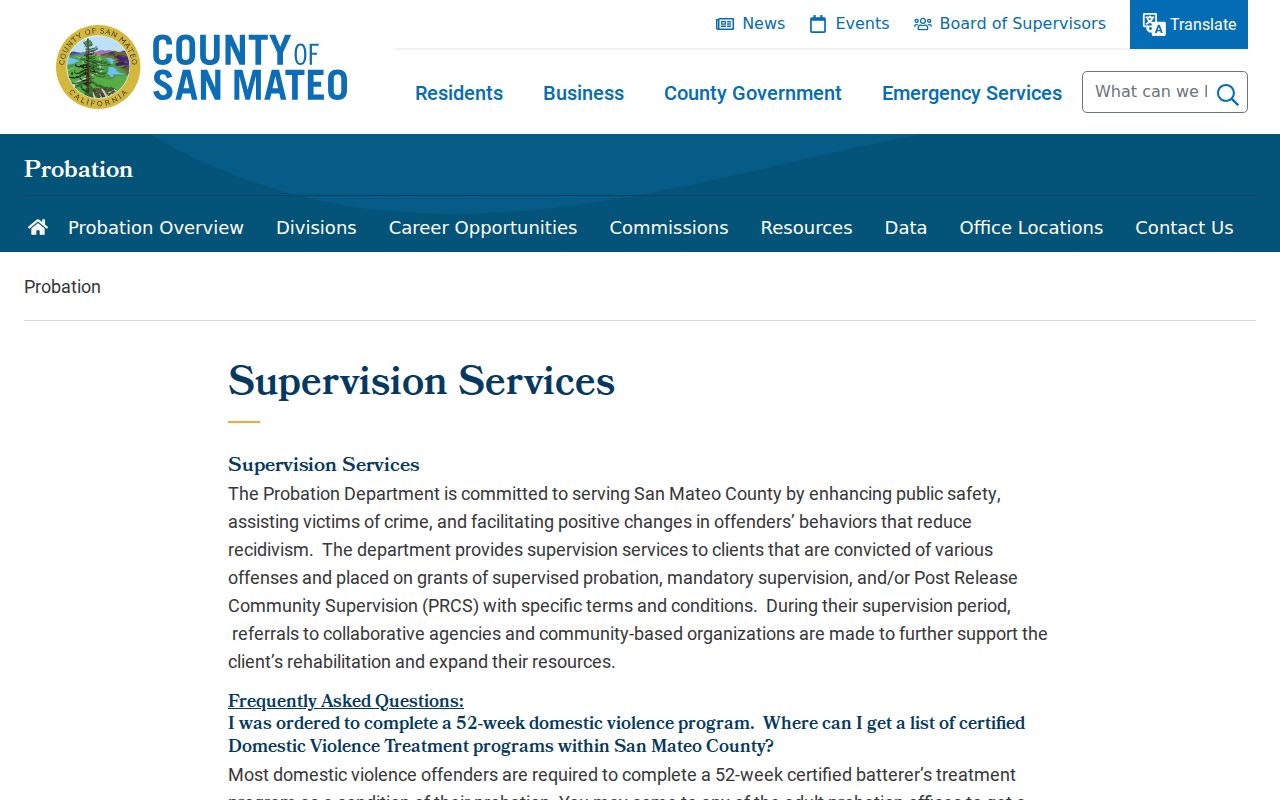
Use that county path for local San Mateo County supervision questions, then use the sheriff records and court channels for the custody and release record itself.
San Mateo State Parole Office
State parole is a CDCR channel, not a county jail counter. The San Mateo-area detail in the research is that the local parole contact is not in Redwood City even though the directory label includes Redwood City coverage. CDCR's Northern Region directory lists "San Jose 1, South Bay GPS, & Redwood City" at 909 Coleman Avenue, San Jose, CA 95110, phone 408-277-1821. This is the practical contact for a person released from CDCR to state parole in the San Mateo area.
CDCR DAPO says it provides access to programs and services that help people transition back to the community. DAPO also maintains a wanted-offenders path for certain parole matters. That does not make DAPO the source for county probation or a San Mateo booking chronology. If the person left Maguire on a local court sentence, start local. If the person left a CDCR prison, start with CDCR, DAPO, and BPH.
- Parole
- State supervision after a prison release, handled by CDCR DAPO for people placed on parole.
- Probation
- Court-ordered local supervision, usually tied to a San Mateo Superior Court sentence or order.
- PRCS
- County supervision after an eligible CDCR release, handled locally rather than by state parole.
- Absconder
- A term for a supervised person alleged to have stopped reporting or become unavailable to the supervising authority.
San Mateo Parole Hearing Records
Some San Mateo County parole and probation research leads to the California Board of Parole Hearings. BPH is part of CDCR and handles parole suitability proceedings and nonviolent offender parole reviews for incarcerated adults under CDCR jurisdiction. BPH does not run the San Mateo County jail and does not supervise county probation. It matters when a San Mateo conviction led to a CDCR sentence and the public question is parole eligibility, hearing outcome, or later state parole.
BPH publishes a parole hearing schedule that includes date, time, location, and whether a hearing is in person or by video. The research says BPH updates schedules weekly every Thursday morning. BPH also publishes parole suitability hearing results by week. Outcomes can include grants, denials, stipulations, postponements, waivers, continuances, rescissions, and other board actions.
Parole eligibility is not release. BPH's parole eligibility information explains that people sentenced to state prison may be eligible for consideration or release based on one or more parole eligible dates. A person can be eligible for a hearing and still not be released. Once BPH grants parole and release processing is complete, DAPO is the supervision channel. If the person is released to PRCS instead, San Mateo County Probation is the better local source.
San Mateo Warrants and Absconders
Absconder and warrant terms need careful handling. An absconder label generally means the supervising agency alleges that a person failed to report or could not be located for supervision. A warrant means a court, board, or authorized authority issued a custody order. Neither label proves why the person first left jail or prison. It may describe a later event after a proper release.
For San Mateo County probation, the court case and county probation channel are the main checks. For state parole, CDCR DAPO and, in some matters, BPH records are the relevant checks. California VINE may show custody status changes after an arrest or return to custody, but VINE is not a full supervision history. If a person is alleged to have violated parole or probation, the public record may split across court minutes, a jail booking chronology, VINE custody status, and the supervising agency.
Note: A San Mateo County release record explains custody movement, while a violation record explains a later supervision event.
San Mateo Reentry After Release
Research for San Mateo County points to a local reentry and jail-family support ecosystem, including the Service League of San Mateo County and jail programs described by the Sheriff's Corrections Division. The sheriff says its correctional services are designed to improve lives during and after incarceration and reduce recidivism. This local context matters because release from custody can involve program placement, property forms, in-custody support, transitional housing, work furlough, electronic monitoring, probation, PRCS, or parole.
Reentry information should not be confused with release proof. A support provider may help with transition needs, but the official status still comes from the jail record, court order, VINE notice, county probation, CDCR parole, or BPH source. The San Mateo County released inmates search workflow is strongest when it treats reentry, release, and supervision as separate parts of the same custody path.
San Mateo Supervision Discharge
Discharge means supervision has ended. For county probation, discharge or termination usually appears through the court and county probation record. For PRCS, the county agency and CDCR release context may both matter. For state parole, DAPO or CDCR records are the better source. The San Mateo jail roster is not built to prove discharge from parole or probation.
California public-records law, now codified at Government Code section 7920.000 and following, governs access to public agency records subject to exemptions. Law-enforcement and supervision records can be partly public and partly withheld. Juvenile, sealed, protected, investigatory, victim, medical, or safety-sensitive material may be restricted. Ask for the narrow record that matches the need: a San Mateo booking chronology for jail custody dates, court minutes for sentence and probation terms, county probation confirmation for local supervision, or CDCR parole records for state parole.