
Transitional Release Paths
The Men's and Women's Transitional Facilities / Transitional Housing Unit is listed by the Sheriff's Corrections Division at the Maple Street address. The research describes it as work-oriented and minimum-security. It houses people who are either in the Sheriff's Work Furlough Program or assigned to perform basic labor-oriented tasks around the facility property. That means release status can be more complex than a standard jail exit.
A person may complete a local jail sentence, finish a work furlough placement, return to locked custody, move to probation, shift to PRCS after a CDCR term, or be subject to a new court order. The public current-custody locator may not explain those program details after the person no longer appears in the jail search. The court file, records bureau chronology, probation record, and program status become more important.
| Status question | Best confirmation source |
|---|---|
| Did the person complete local custody? | Sheriff booking chronology and sentencing court minutes |
| Was the person in work furlough? | Program status, court order, and Alternative Sentencing Bureau context |
| Did supervision follow release? | San Mateo County Probation, PRCS, CDCR parole, or court conditions |
| Did the person transfer elsewhere? | Receiving agency locator, court order, or records bureau response |
Confirm Transitional Release
The first check is still the San Mateo County jail locator if the person may be in active custody. If the person has left the visible roster, use the locator result only as a starting point. Transitional custody may involve planned movement, work-related absence, program completion, failure to report, return to locked custody, or a change in the court order. The record has to answer which event occurred.
- Search the San Mateo County Inmate Locator while custody may still be active.
- Review the San Mateo Superior Court case for the sentence, program recommendation, release order, remand, or probation terms.
- Ask the Sheriff's Criminal Records Bureau for a booking chronology that includes jail or Sheriff's Work Program custody dates.
- Check San Mateo County Probation if the release led to probation, mandatory supervision, or PRCS.
- Use CDCR, BOP, or ICE only when the record shows transfer or custody in those systems.
For a named-person workflow across these channels, use the San Mateo County released inmate search and then narrow the answer to the Transitional Housing Unit records. The key is to separate physical location from legal custody status.
Transitional Unit Contact
The Transitional Housing Unit uses the Maple Street campus address and the Corrections Division phone. Release records, however, often require the records bureau or court. The local records phrase to use is "booking chronology," especially when the request involves jail or Sheriff's Work Program custody dates. If the record question is really about a court-ordered program, the court minutes and Alternative Sentencing Bureau may also be needed.
Transitional Housing Unit
1300 Maple Street
Redwood City, CA 94063
650-599-3000
Minimum-security, work-oriented county custody
Criminal Records Bureau
330 Bradford Street
Redwood City, CA 94063
650-363-4525
Monday-Friday, except holidays, 8 a.m.-5 p.m.
The Sheriff's report-release process may require a case number, identifying information, proof that the requester is an involved party or authorized representative, or a court order for restricted records. A general Public Records Act request can be filed through the county webform, but the sheriff directs personal-records and involved-party report requests to the separate information request process and records email.
Transitional Court Services
Transitional custody is closely tied to court action. A sentence, surrender date, program recommendation, violation, or return-to-custody order can change a person's release status. The San Mateo Superior Court record is often the best source for why the person entered or left a work-oriented placement. MIDX can identify non-confidential and non-sealed cases, while Odyssey portals or clerk channels may provide deeper access where permitted.
Older court records may need extra care. The research notes that San Mateo criminal cases filed before 1993 should be handled through the Criminal Court Clerk's Office rather than relying only on the online index. That matters for a transitional release because an older sentence, warrant recall, probation order, or commitment change may explain why the jail locator has no current result. When a Transitional Housing Unit record appears incomplete, the court case number and clerk channel can be the missing link between jail custody and program completion.
The manifest source below points to the county probation court-services path. The San Mateo County Probation court-services page matters because probation and court services may be involved when a person leaves transitional custody under conditions, supervision, or a modified court order.
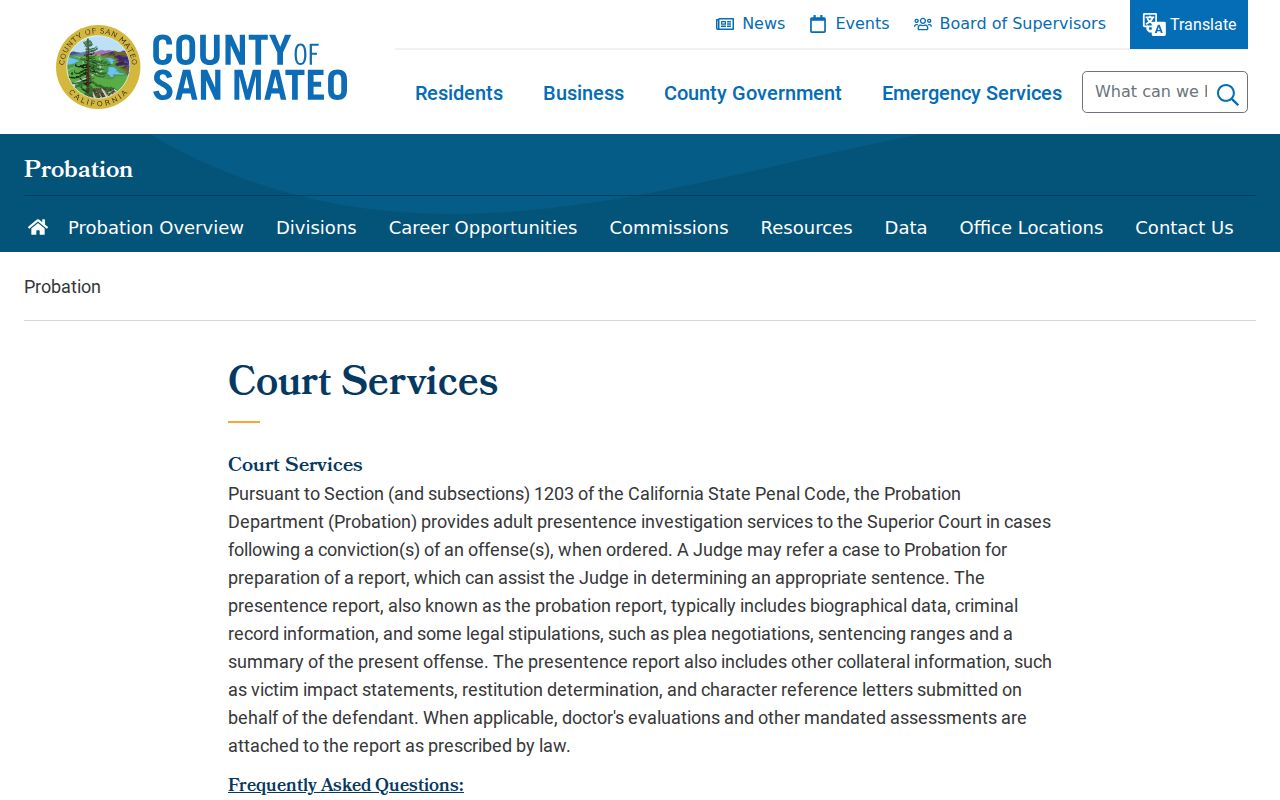
This image supports the practical point: transitional release confirmation may require court and probation context, not just the live jail locator.
Work-Oriented Custody Terms
The Transitional Housing Unit has its own vocabulary. These terms help sort a completed release from program movement or supervision. They are not labels to guess from a locator result. They should be checked against the court order, program record, and sheriff chronology.
- Work furlough
- A court-approved custody arrangement that can allow work-related release while the sentence continues.
- Minimum-security custody
- A lower-security placement still controlled by county jail or program rules.
- Booking chronology
- The Sheriff's record showing San Mateo County Jail or Sheriff's Work Program custody dates and related release information.
- Program completion
- A status that may end a local program term but should be tied back to the court sentence.
Transitional ICE Detainers
San Mateo County's sheriff publishes a local immigration detainer and warrant page. It says the County has an ordinance prohibiting cooperation with immigration authorities and that the Sheriff's Office will not hold, detain, house, transfer, or facilitate an arrest unless there is a judicial warrant or another requirement under law. During the research period, the visible table showed many detainers received, zero detainers acted upon, and four judicial warrants or judicial bookings through May 2026.
For Transitional Housing Unit release research, that policy prevents a common wrong assumption. A detainer request does not by itself prove that a person was kept beyond the county release point or physically transferred to ICE. If the issue is immigration custody, check ICE ODLS. If the issue is a county sentence or program term, use the court record and Sheriff's chronology.
Transitional Facility Links
The Transitional Housing Unit is part of a broader San Mateo County correctional structure. Maguire Correctional Facility is the main jail. Maple Street Correctional Center houses male and female inmates and includes transitional housing. The Alternative Sentencing Bureau handles work program, electronic monitoring, and work furlough applications and approvals.
Those links matter because a person can move among jail custody, transitional placement, alternative sentence status, and supervision. One record rarely tells the whole story. The safest release answer follows the court order and the custody program that last controlled the person.