
San Mateo Projected Release Date
A projected release date is a working estimate, not the same thing as an actual release. In San Mateo County, the estimate may come from a local jail sentence, a current-custody detail page, a court sentence, CDCR calculations, or a later agency record. The research did not confirm from official static sheriff text that the San Mateo inmate locator always displays a public "projected release date" field, although secondary summaries report that field for current inmate detail pages. Treat any online date as a lead until the jail, court, CDCR, or VINE confirms a status change.
Pretrial custody works differently from a sentence. A person waiting for trial may leave because bail is posted, the court orders release, charges are dismissed, or another agency takes custody. A sentenced county jail inmate may have local custody credits under California Penal Code section 4019. A state-prison inmate may have worktime, good-conduct, program, or other CDCR credits. Those systems do not use the same public fields.
County Jail or CDCR Release
The first San Mateo County projected release date question is custody type. Maguire Correctional Facility, Maple Street Correctional Center, the transitional facilities, and the Alternative Sentencing Bureau are county custody or local alternative-custody paths. CDCR is state prison. BOP and ICE are separate federal systems. A San Mateo Superior Court case can move a person from county jail to CDCR, and the local jail release then becomes a transfer rather than a release to the community.
| Custody Path | Date Source | What to Watch |
|---|---|---|
| Pretrial county jail | Court order, bail status, jail status, VINE | No fixed date until the court or custody status changes |
| Sentenced county jail | Jail records, court minutes, local credits | Penal Code section 4019 credits and new holds |
| CDCR state prison | CIRIS, CDCR records, BPH and DAPO records | Public fields may show parole eligibility, not exact release |
| Alternative custody | Court order, program completion, probation status | Out of a jail bed can still mean serving a local custody term |
Find San Mateo Release Date
Use more than one source for a San Mateo County projected release date. The county inmate locator is useful around active custody, but the research says the official public text frames it as a current-custody tool, not a durable released-inmate archive. The Sheriff's Criminal Records Bureau booking chronology, the San Mateo Superior Court case, California VINE, CDCR CIRIS, and supervision records may each answer a different part of the date question.
- Start with the last known facility or program: Maguire, Maple Street, transitional housing, Alternative Sentencing Bureau, CDCR, BOP, or ICE.
- Check the San Mateo jail locator if county custody may still be active, then avoid treating "no result" as proof of release.
- Use the San Mateo Superior Court case to read sentence, bail, remand, probation, dismissal, or CDCR commitment entries.
- For a county jail sentence, request the booking chronology or release confirmation from the Sheriff's Criminal Records Bureau.
- For a CDCR sentence, search CIRIS and then use CDCR case records, BPH, DAPO, or PRCS channels when public fields are not enough.
- For a near-term release alert, use California VINE while the person is still in custody.
The San Mateo County released inmates record workflow is most useful after the date passes, because it explains how to move from current custody to a booking chronology, court disposition, supervision status, or federal release record.
San Mateo Jail Credit Rules
County jail release-date computation starts with the court sentence and local custody credits. California Penal Code section 4019 applies in specified county jail, city jail, industrial farm, road camp, and related local custody contexts. It is one reason a San Mateo County jail release date can be earlier than a plain calendar count. Actual days, conduct credits, time already served, sentence changes, court orders, and new holds can all affect the date.
The official California public-law mirror for Penal Code section 4019 is a matching manifest image for projected release-date research. The source helps explain why a county jail sentence is not read by simply counting days from the booking date.
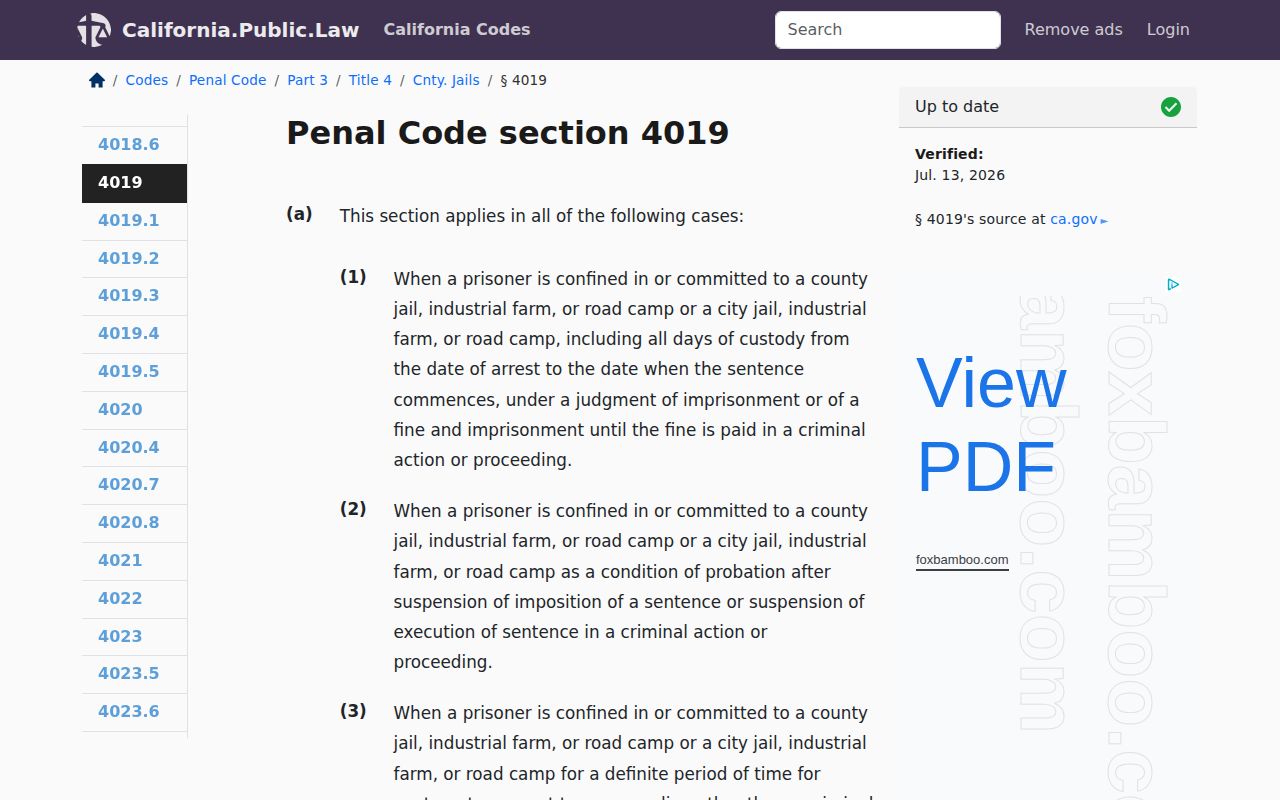
Use the statute as legal context, then verify the person's own date through the court and the sheriff records channel because credits and holds are case-specific.
CDCR Release Date Credit
For state prison, CDCR uses sentence calculation, worktime credits, good-conduct credits, program credits, disciplinary credit losses or restorations, parole rules, resentencing, and court orders. Penal Code section 2933 is the state-prison worktime credit statute for determinate sentences. Penal Code section 2933.1 limits credits for people convicted of violent felonies listed in Penal Code section 667.5(c). The common shorthand is roughly 85 percent service for qualifying violent felonies because credits may be limited to 15 percent, but final calculations can be more complex.
CDCR public CIRIS descriptions do not promise a full exact projected release date for every current prisoner. They emphasize name, CDCR number, age, current location, commitment counties, admission date, parole eligible date by month and year, and BPH dates or outcomes where applicable. A San Mateo County conviction may appear as a commitment county, even if the person is housed somewhere else in California.
The manifest includes a source image for Penal Code section 2933, which is the state-prison worktime credit statute used in release-date context.
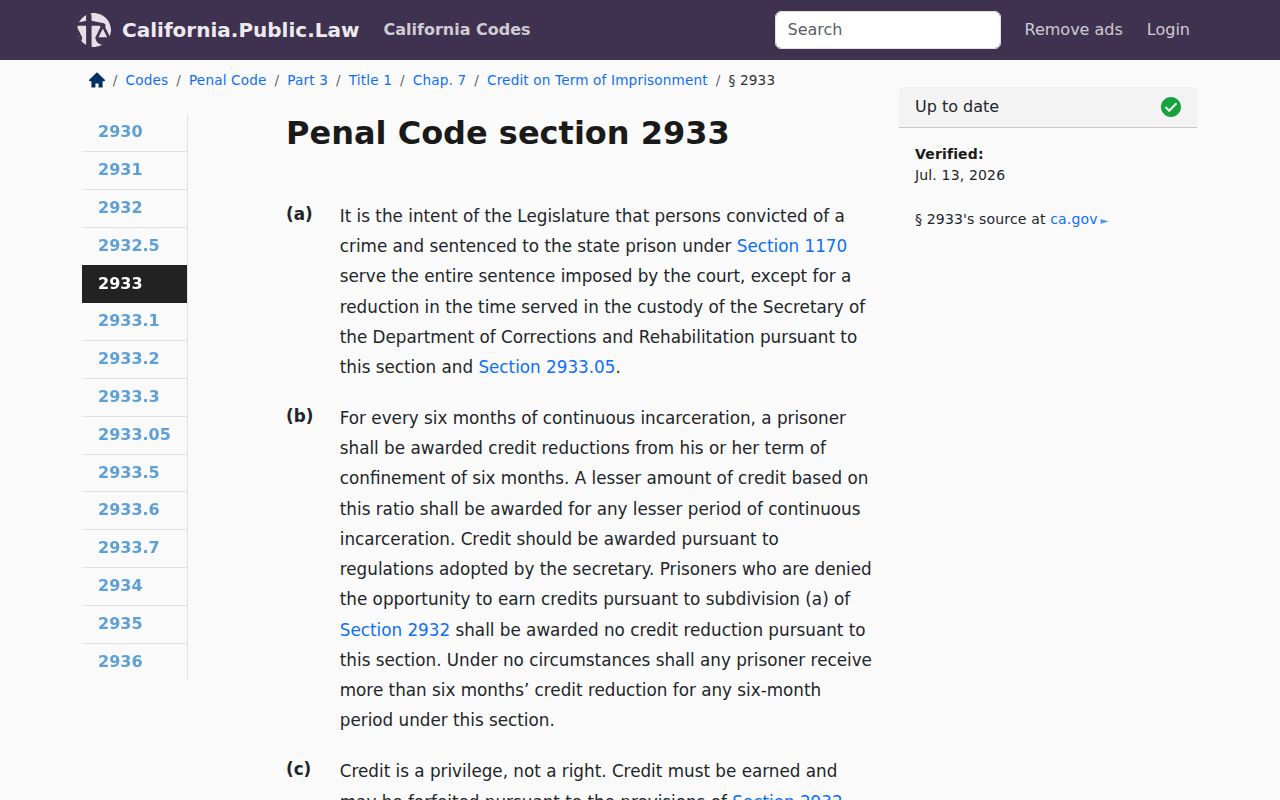
For an exact CDCR date, the institution case records office, release paperwork, parole records, or CDCR records process may be needed after the public search is checked.
San Mateo CIRIS Date Fields
California's state prison locator is CDCR CIRIS. The research says the CA.gov service page describes CIRIS as the California Incarcerated Records and Information Search and lists public result fields for currently incarcerated people. CIRIS is important for a San Mateo County projected release date only after the person is in CDCR custody or when a San Mateo commitment county connects a prison record to the local case.
| CIRIS Field | Release-Date Value |
|---|---|
| Name and CDCR number | Match the person and avoid relying on a common name alone |
| Current location | Shows state custody location when the person is currently in CDCR |
| Commitment counties | May connect the prison record to a San Mateo County conviction |
| Admission date | Places the state sentence in time but does not equal release |
| Parole eligible date or BPH actions | May show parole eligibility or board history, not a guaranteed release date |
Why San Mateo Dates Change
A projected date can move earlier or later. CDCR's credit guidance and three-judge court updates show that credit-earning changes can affect advance release dates. County jail dates can also change quickly when court orders, bail decisions, sentence modifications, or holds change. The closer the release is, the more important it is to verify through the holding agency and court record.
| Change Factor | Possible Effect |
|---|---|
| Court amended sentence | Can shorten, lengthen, or restructure the custody term |
| Custody credit recalculation | Can move a county jail or CDCR date after credits are applied |
| Disciplinary credit loss | Can push a state-prison date later, subject to restoration rules |
| New warrant or hold | Can block release or create transfer to another agency |
| BPH action or parole review | Can affect parole timing for eligible CDCR inmates |
| Paperwork or notification timing | Can delay actual release after a projected date is reached |
San Mateo Release Computation Split
Section 19 flags a San Mateo-specific release-date angle: local and state calculations split fast. County jail dates depend on Penal Code section 4019, court orders, holds, and jail processing. CDCR dates depend on section 2933, section 2933.1, violent-felony limits, CDCR credit rules, BPH action, and case-record processing. A person in the Alternative Sentencing Bureau may be outside a locked jail bed while still serving a court-ordered custody sentence.
That split is the reason online calculators can mislead. A calculator usually cannot see a San Mateo court minute order, a new hold, a work furlough status, a PRCS placement, or a CDCR credit restoration. The official date comes from the agency that holds or supervises the person, with the court record used to explain the sentence. Note: Verify a projected San Mateo County release date close to the event because same-week court and hold changes can override an older estimate.
Confirm San Mateo Release Date
Confirmation should match the custody path. For Maguire, Maple Street, transitional custody, or the Alternative Sentencing Bureau, use the jail or sheriff records channel and the San Mateo Superior Court record. For CDCR, use CIRIS first, then CDCR case records, parole, BPH, or PRCS channels. For VINE, register before release when possible, because VINE is strongest as a custody-change notification tool. For federal custody, BOP has its own locator and release-date rules.
Ask precise questions. "Is this person released?" is less useful than a request for the booking chronology, the court minute order, the CDCR release paperwork, or the agency status tied to a specific booking, case, or CDCR number. If a person disappears from a current-custody locator, that may mean release, transfer, data delay, name mismatch, or a restricted record. A positive source is still needed.